Guide · Performance · 3 min read
Twin keel upwind performance: what you need to know
Why a twin keeler loses a little pointing upwind, why the gap fades on other points of sail, and how to trim a twin keeler to sail well to windward.

Why a twin keeler loses a little pointing upwind, why the gap fades on other points of sail, and how to trim a twin keeler to sail well to windward.
Twin keelers carry a reputation for being slow upwind, inherited from the 1970s, when many designs combined two short, thick keels with heavy hulls. Those boats pointed poorly, and the image stuck.
Modern twin keelers have little in common with them: profiled, angled keels designed together with the hull, on wide and light hulls. The question deserves to be asked again with concrete facts.
Upwind, a keel generates a sideways force that resists leeway. Two shallower keels produce this force with more wetted surface and a lower aspect ratio than a single deep keel. That is the real origin of the gap: a little more drag and a little less efficiency for the same lift.
But the boat does not sail upright. When heeled, the leeward keel comes closer to vertical and works in good conditions, while the windward keel is unloaded and partly lifts out of the water. Part of the handicap therefore disappears as soon as the boat takes up its normal angle of heel.
| Point of sail | Twin vs fin keel gap | Comment |
|---|---|---|
| Close-hauled, flat water | Noticeable | A few degrees less pointing |
| Close-hauled, rough sea | Reduced | Speed matters more than pointing |
| Close reach, beam reach | Small | The hull makes the difference |
| Downwind | Negligible | Sail plan and weight dominate |
General trends for comparable designs, not measurements.
It would be dishonest to deny it: with comparable design, a twin keeler points slightly lower than a fin keeler, especially in light airs and flat water where leeway is felt. The difference is a few degrees.
On a real cruise, close-hauled sailing is a modest share of the time. The difference in daily average is small, and often offset by being able to take passages and short cuts closed to a fin keeler.

From a close reach through beam reach to downwind, the difference becomes hard to measure. Speed then depends mainly on the hull, weight and sail plan. A wide, powerful hull derived from offshore racing keeps its speed and directional stability whatever the keel configuration.
Twin rudders, fitted on wide hulls, keep a grip in the water when heeled and ensure constant control of the helm. They are a key element of behaviour both upwind and downwind.
A twin keeler is sailed for speed first. Rather than pinching to gain a few degrees, bear away slightly to keep speed: the keels work better, leeway decreases and actual pointing improves.
Keep heel moderate so the leeward keel keeps a good angle of attack: reef early, ease the mainsail in gusts and trim the genoa carefully. It gets better results than forcing, and in a seaway it also spares the crew.
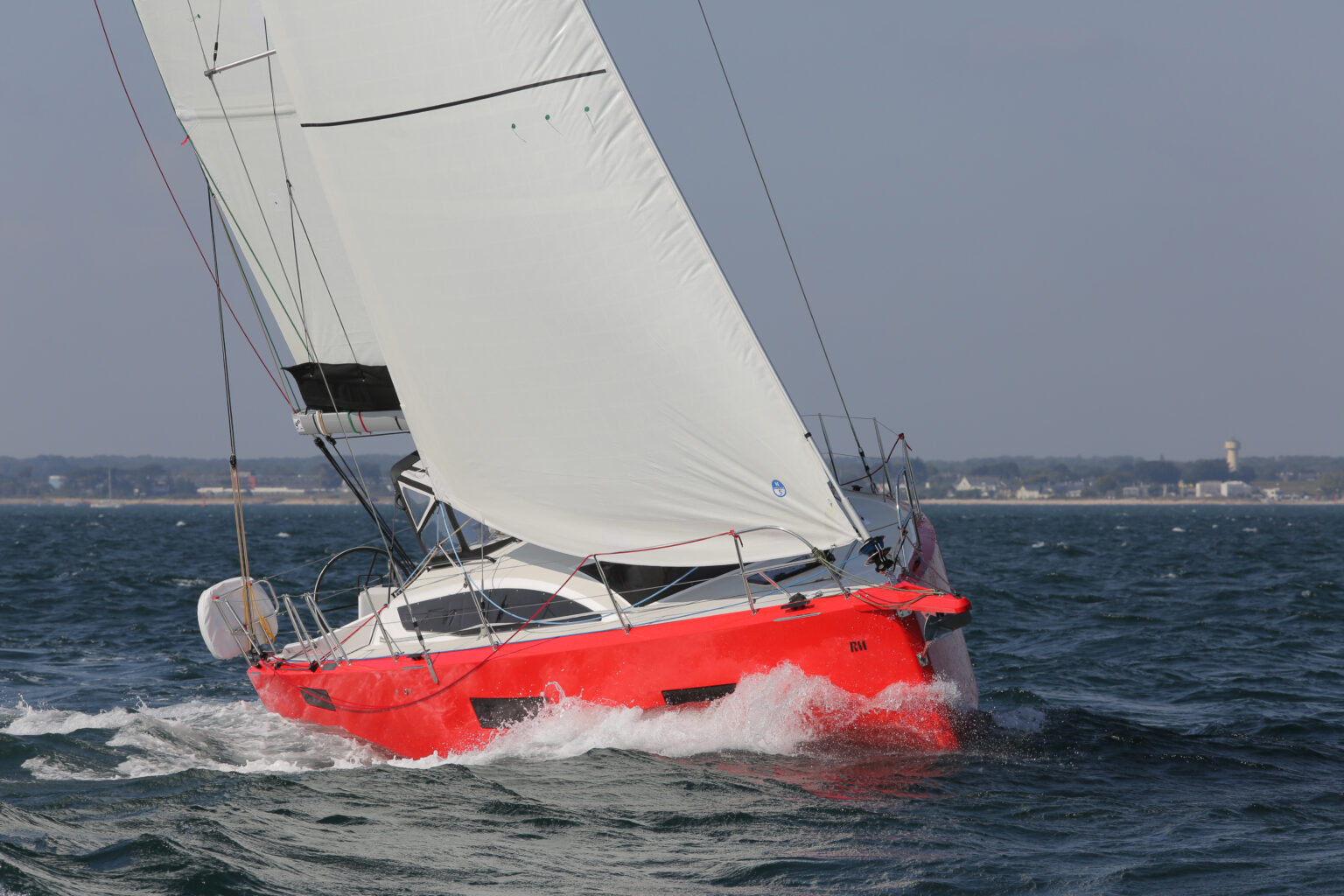
The real question is not whether a twin keeler loses upwind, but whether what it brings is worth those few degrees: drying out, anchorages that uncover, 30 to 40 centimetres less draft and simpler haul-outs.
For a programme in the Channel, Brittany or on the Atlantic coast, the answer is usually yes. In the Mediterranean, the fin keel keeps the edge. At RM, most models come in both versions, so you can choose according to your sailing area rather than the boat.
The full twin keel vs fin keel comparison, and our guide to sailing a drying-out boat in tidal waters.
Slightly less close-hauled, by a few degrees, especially in light airs and flat water. The gap becomes small on other points of sail.
Two shallower keels generate the anti-leeway force with more wetted surface and less efficiency than a single deep keel. When heeled, the leeward keel comes closer to vertical, which reduces part of the gap.
By favouring speed over pointing: bear away slightly rather than pinching, keep heel moderate by reefing early, and trim the genoa carefully.
Very little. Close-hauled sailing is only a small share of the time, and speed on other points of sail depends mainly on the hull and sail plan.
They mainly improve control: when heeled, the leeward rudder stays immersed, giving a balanced helm and preventing broaching on wide hulls.
WhatsApp us